
Jamie Benning, writing at ILM.com, talks to visual effects supervisor Eric Leven as he takes us behind the scenes of F1: The Movie, the high-speed film from director Joseph Kosinski.
There is a moment early in F1: The Movie (2025) when the film quietly makes a promise to its audience. Before we have settled into the present-day story, and before we have learned the rhythms of the modern races, we are pulled back into the past, into the memory of a catastrophic crash that defines Sonny Hayes (Brad Pitt) long before we meet him. It is a short sequence, but it carries the same burden as the first dinosaur reveal in Jurassic Park (1993). If the audience does not believe this moment, everything that follows becomes harder to land.
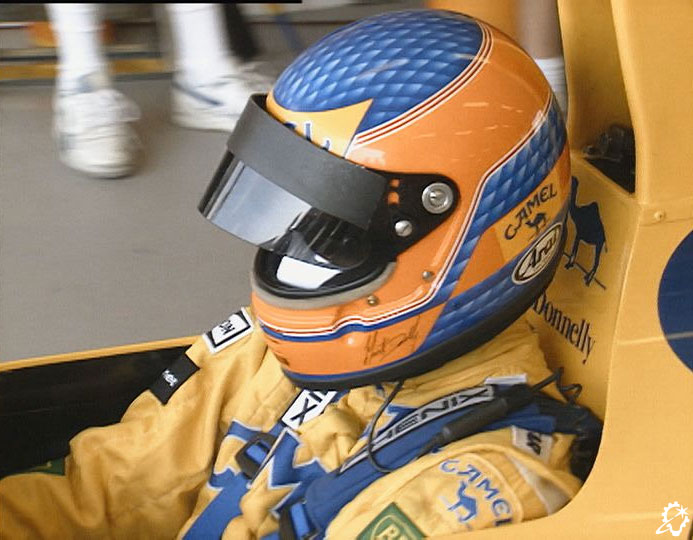
That opening crash is not simply exposition. It is the film’s tonal contract, shaped quietly by Industrial Light & Magic, with more than a little help from the real-life, near-fatal crash of racing driver Martin Donnelly at Jerez in 1990.
ILM visual effects supervisor Eric Leven described the challenge in clear terms. “Motorsport fans have watched countless hours of real racing footage, so they instinctively know when something feels wrong. A film, however, cannot simply document reality. It has to reshape it into something emotional and cinematic. Accuracy alone is never enough.”
I have worked in Formula One television production for more than twenty-five seasons, and when the Donnelly sequence began as I watched the movie, I recognized the real-world imagery within a second. Almost immediately, that recognition dissolved, and I found myself inside Sonny’s memories. I wanted to understand how ILM helped achieve that transition and set the tone for the entire movie.


Dreaming in VHS
The conceit of the opening sequence is simple and effective. Sonny dreams in VHS. Editorial had mocked up an early version of the look, but everyone knew how unforgiving that format could be.
“Everyone knows exactly what real VHS looks like,” says Leven. “And if it is just a tiny bit off, you can tell that it was done in post or that it is not real VHS.”
Rather than rely on digital simulations, ILM turned to genuine analogue artefacts. Leven had digitized old family VHS tapes, complete with dropouts, noise, and tracking errors. Those became the foundation of the sequence.
“We were able to lift glitches from real VHS tapes,” Leven explains. “Our compositing supervisor, Heath Kranak, put that material together and mimicked the rest of the VHS look with the color desaturation and low fidelity and it matched perfectly. It was a really, really fun sequence to work on.”
The result does not feel stylised. It feels remembered and slightly damaged. The fragility it imparts is central to the emotional impact of the moment.

Rebuilding History, Donnelly, Senna, and the 1990s
Texture is only one part of the illusion. Many of the elements that appear in the Sonny Hayes crash exist because ILM reconstructed them digitally. The sequence blends archive racing footage of Martin Donnelly with new photography shot at the F1 legacy circuit Brands Hatch. Crucially, the archive was not something to be polished. It was the aim.
“The archive footage was the target look we were going for,” Leven says. “That became our roadmap for what the other footage needed to look like.”
The new material had to bend toward the old. Stand-in cars did not match the shapes and proportions of early 1990s Formula One vehicles, so ILM made significant changes. “To me it looked like a Formula One car from the 1990s,” Leven notes. “But people said, no, the air scoop is different, and the tires are a little bit fatter. So we ended up replacing Senna’s car in its entirety.”
Branding needed the same attention. Logos removed on set were later reinstated for reasons of authenticity. “At that time they had Marlboro advertising,” Leven recalls. “So we added those logos onto Senna’s car and on some of the billboards.”


Playing With Recognition
For viewers who know the real Martin Donnelly crash at Jerez in 1990, there is an immediate flicker of recognition when the sequence begins. The angles, trackside details, and violence of the moment feel unmistakably familiar. Yet within seconds, that certainty slips.
The yellow car remains, but the driver is no longer Donnelly. The incident has been reframed as Sonny Hayes’s defining memory, and from that point on, the sequence belongs to the character rather than history. ILM is not inserting new material into archival reference. It is reconstructing a memory, taking an incident that fans may hold vividly in their minds and reshaping it so the audience feels both recognition and unease.
That approach extends beyond the car itself. Although the sequence was shot at Brands Hatch, ILM removed contemporary details, replaced the environment, added period-appropriate crowds, and regraded the landscape to resemble the Spanish circuit of the early 1990s. For seasoned Formula One fans, this is where the spell takes hold. They recognize the shape of what they are seeing, but begin to question its ownership.

Read the article in full here, and watch F1: The Movie on Apple TV.
The post ILM’s Invisible Work on ‘F1: The Movie’ appeared first on Jedi News.